
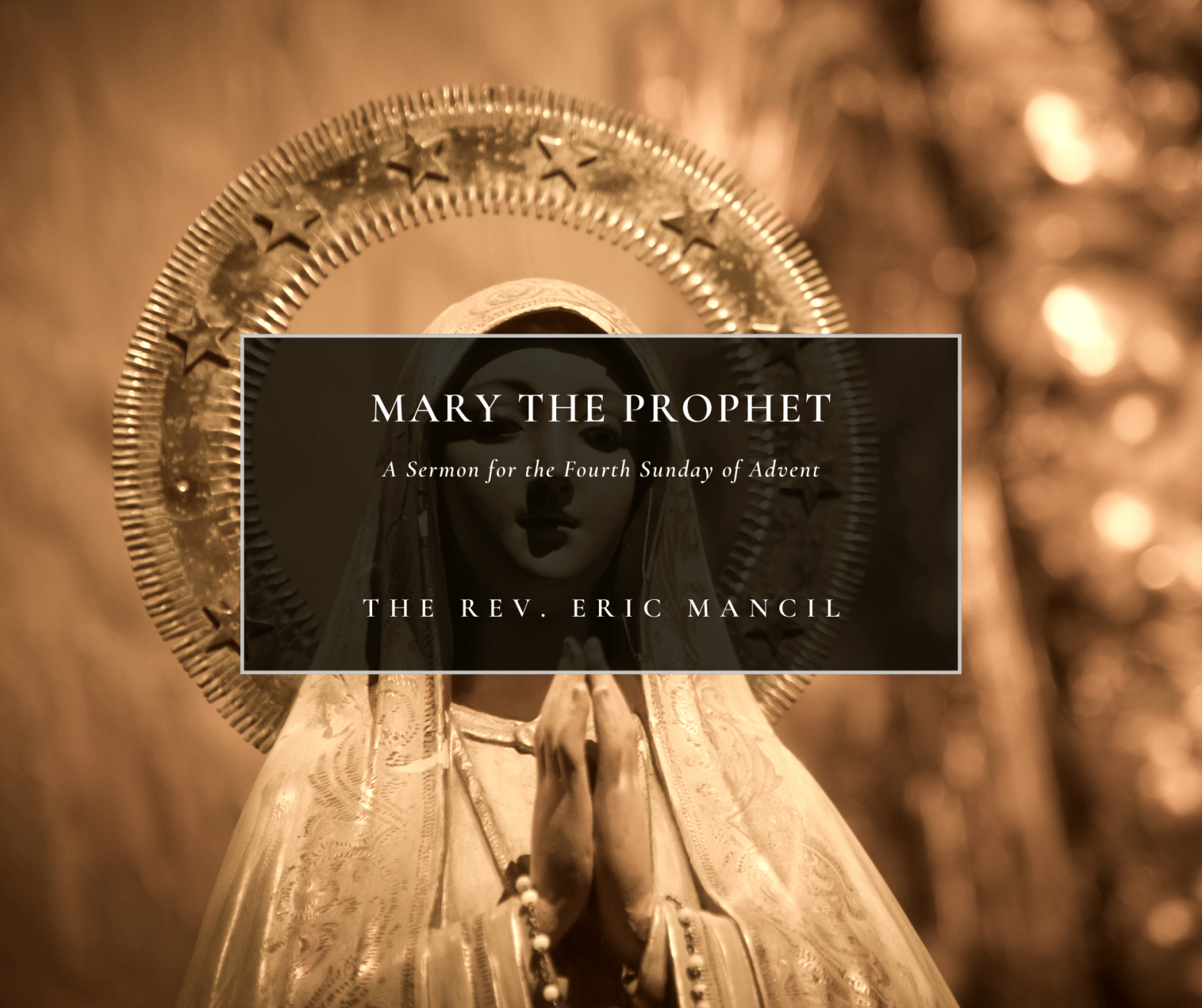
A Sermon for the Fourth Sunday of Advent (Year C)
December 19, 2021
Text: Luke 1:39-50
I speak to you in the name of our loving, liberating, and life-giving God: Father, Son, and Holy Spirit. Amen.
Good morning, friends. I’m so glad you could join us at church this morning for the fourth and final Sunday of Advent as we begin to turn the corner from one season of the Church year to another and make our final preparations for Christmas. I’d like to begin my sermon this morning by sharing with you a poem from one of my favorite Christian poets, Malcolm Guite, who also serves as a priest in the Church of England. The title of this poem is “The Visitation,” and it’s based on the lesson we heard just a few moments ago from Luke’s Gospel.
The poet writes,
Here is a meeting made of hidden joys,
Of lightenings cloistered in a narrow place,
From quiet hearts the sudden flame of praise
And in the womb the quickening kick of grace.
Two women on the very edge of things
Unnoticed and unknown to men of power,
But in their flesh the hidden Spirit sings
And in their lives the buds of blessing flower
And Mary stands with all we call ‘too young’,
Elizabeth with all called ‘past their prime’.
They sing today for all the great unsung,
Women who turned eternity to time,
Favoured of heaven, outcast on the earth,
Prophets who bring the best in us to birth.
We have a lot of words and titles that we often associate with the Blessed Virgin Mary, especially during this time of year as we draw closer and closer to our celebration of Jesus’ birth. You can find a lot of these words and titles in the Christmas carols we sing at church, such as “The angel Gabriel from heaven came,” which refers to Mary as “Most Highly Favored Lady” or the beloved hymn, “Once in Royal David’s City,” which includes these lyrics in the first verse: “Mary was that mother mild, Jesus Christ her little child.”
Yes, we use all sorts of words and titles to describe Mary, such as “Blessed Mother,” “Our Lady,” “Queen of Heaven,” and perhaps my favorite title of all—theotokos, which is a Greek word, meaning “God bearer.” All of these words and titles beautifully capture our love for Mary and the qualities we admire most about her.
But, there’s one title we rarely use to describe Mary, even though it’s perfectly appropriate, especially when you consider the story we heard earlier in our Gospel reading when Mary goes to visit her cousin, Elizabeth, soon after she receives the announcement from the angel Gabriel that she will give birth to God’s only Son. The title I’m referring to is “prophet.” We rarely, if ever, use the word “prophet” to describe Mary, and yet, that’s exactly the role she plays in our Gospel lesson this morning as she delivers the beautiful and poetic words of her Magnificat.
Listen to the words again.
Mary said to Elizabeth, “My soul proclaims the greatness of the Lord, my spirit rejoices in God my Savior; for he has looked with favor on his lowly servant. From this day all generations will call me blessed: the Almighty has done great things for me, and holy is his Name. He has mercy on those who fear him in every generation. He has shown the strength of his arm, he has scattered the proud in their conceit. He has cast down the mighty from their thrones, and has lifted up the lowly. He has filled the hungry with good things, and the rich he has sent away empty. He has come to the help of his servant Israel, for he has remembered his promise of mercy, the promise he made to our fathers, to Abraham and his children for ever.”
When we hear the term, “prophet,” we typically think about those monumental figures from the Old Testament, don’t we—people like Elijah, who we read about in First and Second Kings, and Isaiah, and Jeremiah, those who were called by God to serve as messengers, often foretelling the future and beckoning the people of Israel to repent and return to the Lord. John the Baptist, who we’ve read about in our Gospel readings for the past two weeks, would also fall into the category of prophet with his message of repentance and his call to the people to prepare a place for the coming of the Messiah.
So, what is it about Mary that makes her a prophet, and why are the words of her Magnificat so important?
In his book, The Prophetic Imagination, author Walter Brueggemann writes, “The task of prophetic ministry is to nurture, nourish, and evoke a consciousness and perception alternative to the consciousness and perception of the dominant culture around us.” Or, as another author writes, “The prophet…is somebody whose role is always to be challenging the community to be what it is meant to be—to live out the gift that God has given to it.”
The prophetic role of Mary challenges us to ask questions about the way things are in the world around us. Her role as prophet calls us to be critical of the status quo, to remember who we are and who we were created to be in the image and likeness of God. In the words of her Magnificat, Mary reminds us that it won’t be the privileged or the powerful or those who think they’re more important than others who inherit the Kingdom of God. It’ll be those who exhibit true humility and those who work to fulfill God’s dream for heaven on earth.
All of it is part of God’s “divine reversal,” a common theme found throughout the Gospel of Luke that will continue to be prevalent in our Gospel readings for many weeks to come.
Mary provides us with a perfect example of humility and modesty, and the words of her Magnificat reinforce Luke’s theme of the “divine reversal,” of a world turned upside down by the coming of the Messiah. Her words remind us that what we know to be true about the world will not be true about God’s Kingdom. The powerful have been brought down from their thrones, and the lowly have been lifted up. The hungry have been filled with good things, and the rich have been sent away empty-handed. Later in Luke’s Gospel, Jesus will speak further about God’s “divine reversal” in his Sermon on the Plain when he says to the crowd, “Blessed are you who are poor, for yours is the Kingdom of God. Blessed are you who are hungry now, for you will be filled. Blessed are you who weep now, for you will laugh.”
In other words, God has a plan to bring redemption and restoration to God’s creation, and all of it begins with Jesus.
The roles of Mary and Elizabeth also signify this upside down world inaugurated with the birth of Jesus. As one author comments, “Two marginalized, pregnant women carry the future and proclaim the Messiah.” Mary, a young, poor, and unmarried woman from Nazareth, and Elizabeth, a woman far too old and weak to conceive and give birth, carry in their wombs the herald of the Messiah and the salvation of the world.
This Friday is when we’ll celebrate the Feast of the Nativity—our bold proclamation, as Christians, that the light of the world has come down from heaven to usher in the Kingdom of God. What that means for us, dear friends, is that now is the perfect time for us to consider how we, like Mary, will carry the love of God into a world that’s in desperate need of a Savior. Now is the perfect time for us to consider how we, like Mary, will be “God Bearers” to those whom we encounter in our everyday lives and messengers of hope to those who’ve been cast down and ignored. Now is the perfect time for us to consider how we, like Mary, are being called to challenge the way things are and to proclaim that the Kingdom of God belongs to the humble and meek, the poor and the lowly.
In this last week of Advent, how is God calling you to bring forth Jesus into the world? How is God calling you to help turn the world upside down, which, in the words of our Presiding Bishop, is really “right side up”?
As we prepare to once again celebrate the birth of Jesus and welcome the newborn King lying in the manger, let us also prepare our hearts to give birth to the love of God in Christ Jesus so that those to whom we’re sent may come to know that perfect love that knows no boundaries or limits. Amen.
A video of this sermon can be found at the following link, beginning at the 19:10 mark.
https://www.facebook.com/holyspiritalabaster/videos/628377455108181
 The Rev. Eric Mancil