
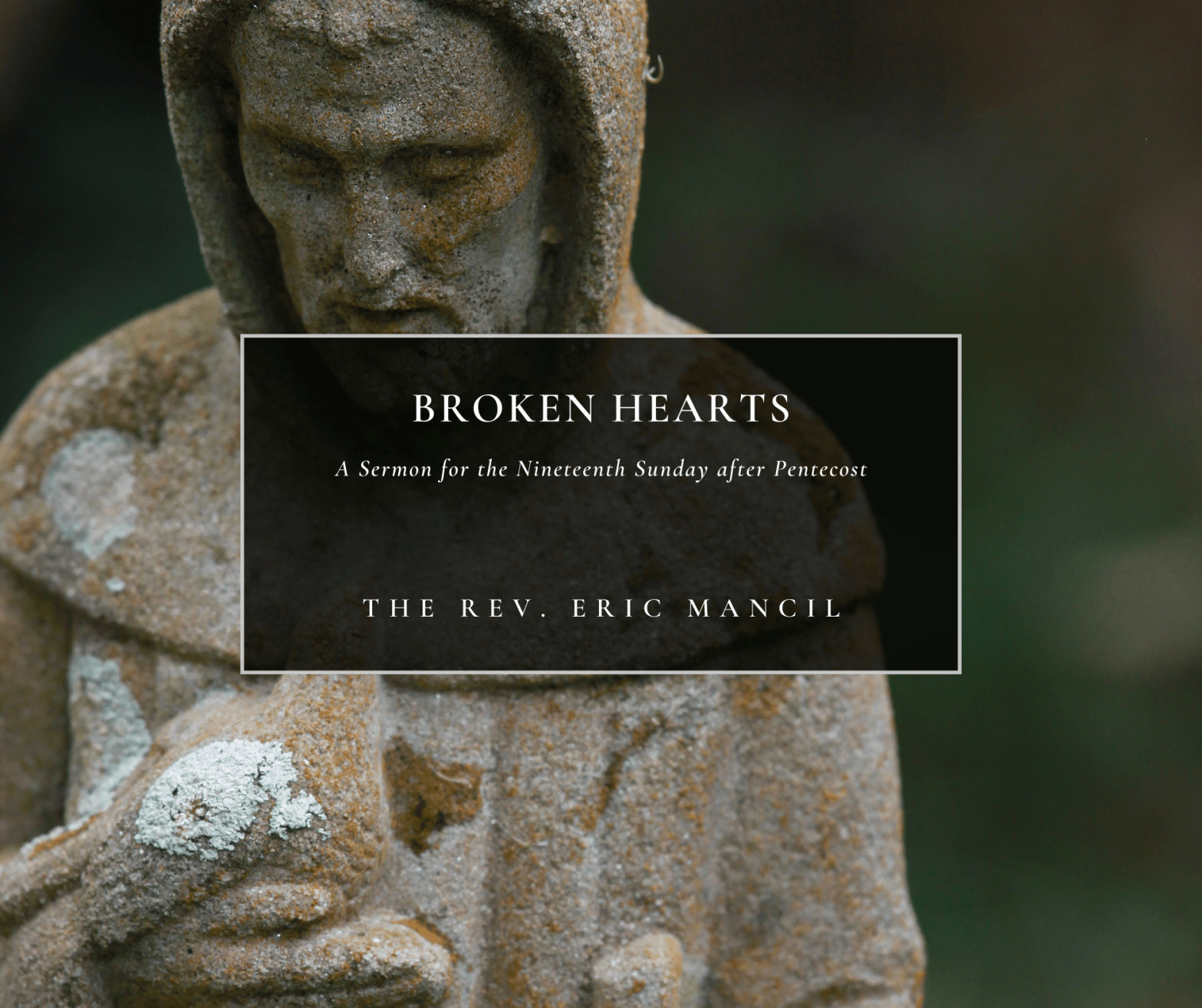
A Sermon for the Nineteenth Sunday after Pentecost (Proper 22, Year B)
October 3, 2021
Text: Mark 10:2-16
I speak to you in the name of our loving, liberating, and life-giving God: Father, Son, and Holy Spirit. Amen.
C.S. Lewis once wrote, “To love at all is to be vulnerable. Love anything, and your heart will certainly be wrung and possibly be broken. If you want to make sure of keeping it intact, you must give your heart to no one, not even to an animal. Wrap it carefully round with hobbies and little luxuries; avoid all entanglements; lock it up safe in the casket or coffin of your selfishness. But in that casket — safe, dark, motionless, airless — it will change. It will not be broken; it will become unbreakable, impenetrable, irredeemable. The alternative to tragedy, or at least to the risk of tragedy, is damnation. The only place outside of Heaven where you can be perfectly safe from all the dangers and perturbations of love is Hell.”
Loving others requires us to take risks. Ask anyone who is married or in a committed relationship, and they’ll tell you the same thing. Sharing our heart with another person requires an unbelievable amount of trust and vulnerability. And, it requires a leap of faith, because nothing is certain about the future. One day, you could be perfectly happy, and the next day, something could go terribly wrong, affecting your relationship with that person forever.
Yes, loving requires risk, and it’s certainly a risk that two people take when they willingly enter into the covenant of marriage. They make vows, in the presence of God and God’s people, to love and comfort each other, to honor and keep each other, in sickness and in health, and to be faithful as long as they both shall live. As the rite for Holy Matrimony states in The Book of Prayer Prayer, “marriage is not to be entered into unadvisedly or lightly, but reverently, deliberately, and in accordance with the purposes for which it was instituted by God.”
But, what happens when, for some reason, the relationship that once existed between two married people has faded into something unrecognizable–when living together has caused their hearts to be broken so many times that they’ve become hardened and impenetrable?
Do they stay together? Or, do they find a new way of living out their marriage vows to one another? Do they keep living miserable lives? Or, do they come to the realization that, despite the pain that it may cause—for themselves and for others—letting go and moving on could actually save their lives?
In today’s lesson from Mark, we hear one of the most controversial teachings of Jesus found in the Gospels—Jesus’ teaching on divorce. It’s certainly not the most enjoyable passage in Scripture, especially for those of us who’ve been affected by divorce, either in our own relationships or in those of close friends and family members. But, I think it’s important for us to discuss it—not to casually ignore it— because lying beneath the surface of what Jesus says in today’s lesson is an important truth that can help all of grow in our relationships with God and each other.
At the beginning of the passage, the Pharisees come to Jesus to test him and to expose him as a false prophet. They ask him, “Is it lawful for a man to divorce his wife?” As a diligent student of the Hebrew Scriptures, Jesus is well aware of the law to which the Pharisees are referring—an ancient law decreed by Moses in the Book of Deuteronomy, which permitted men to issue bills of dismissal to their wives if they were unpleased with them. Jesus explains to the Pharisees, “Because of your hardness of heart Moses wrote this commandment for you. But from the beginning of creation, ‘God made them male and female.’ ‘For this reason a man shall leave his father and mother and be joined to his wife, and the two shall become one flesh.’ So they are no longer two, but one flesh. Therefore what God has joined together, let no one separate.”
When we read this passage from Mark’s Gospel, I think it’s important for us to have a little bit of historical and cultural context. It’s important for us to understand that, in the time of Jesus, it was very easy for a man to issue a certificate of divorce and dismiss his wife for any reason. It was as easy as signing a bill. Women had very little rights to begin with, but when they were divorced from their husbands, they also lost the right to own property. Often, this would lead to women being left stranded and homeless, with no other option than to beg for food or sell their bodies for money.
So, one way to interpret Jesus’ teaching in this passage is that it’s a call for compassion and mercy. It’s a call for us to take care of the most vulnerable members of our society, including those who have very little rights or privileges.
I also think it would be short-sighted for us to read this passage and immediately assume that Jesus is completely against divorce, at least in the way that we think of it today. As with most things, it isn’t a “black or white” issue. We know, through our own experiences, that marriages come to an end for lots of different reasons, and we’ve come to understand that living through painful experiences and making tough decisions, like the decision to end a marriage, can actually lead to healing and restoration. We’ve come to understand that letting go of things that are unhealthy in our lives, including broken relationships, can be a source of life.
Now, don’t get me wrong. This doesn’t mean that I think Jesus wants all of us to go out and get divorced at the first sign of trouble. On the contrary, I think Jesus wants us to work hard to try and mend broken relationships, especially in marriage, because the covenant made between two people in the sacrament of Holy Matrimony is not just about the couple getting married. For us, marriage represents something far greater. It’s a sign of God’s self-giving, sacrificial love for us, the kind of love that we’re called share with others in return. Marriage is intended by God to serve as an example of what God’s Kingdom looks like—an example of mutual respect and concern for the other over the self.
God grieves with us any time we experience the end of a marriage or any other close, intimate relationship. But, I’m also convinced that God desires for us to live full and healthy lives and to love others, despite the risk of being heartbroken. As C.S. Lewis put it, to do otherwise—to shield ourselves from the possibility of a broken heart—is the same as cutting ourselves off from God.
Jesus teaches us in today’s Gospel lesson that in order to live in God’s Kingdom, in order to live the full and abundant lives that God intends for us, we must not allow ourselves to give in to our own, selfish desires or allow our hearts to be hardened. Instead, we must allow ourselves to be vulnerable and open, even at the risk of being hurt.
It’s fitting that today, on the Nineteenth Sunday after Pentecost, we’re also taking time to commemorate and give thanks for the ministry of St. Francis of Assisi in our Blessing of the Animals service. As many of you know, St. Francis had a passion for taking care of God’s creation. We typically remember him as the patron saint of animals and the environment. Each year, on or around his feast day, we get to bring our beloved pets to church for a special blessing. However, Francis also had a passion for taking care of people. As a young man, he dedicated his life to serving the poor, and he felt called to renounce anything of material value, embracing a life of poverty. When he established his own monastic order, he required his Friars to do the same, to live in solidarity with those who had nothing. For Francis, this act of letting go of material things was his way of responding to God’s call to live with compassion—to live with a broken heart so that the love of God may flow through him and reach others.
Imagine what the world might look like if only we were willing to live as Francis lived. Imagine what the world might look like if only we were willing to let go of our need to avoid the pain and suffering of others, to let go of those things that prevent us from living with broken hearts.
To do so would mean opening ourselves to the possibility of being hurt, but it would also mean opening ourselves to the possibility of abundant life with God. As Christians, this is our calling. We’re called to live with compassion and to respond to the needs and concerns of the world around us, and make no mistake about it, my brothers and sisters—our world is in need. All you have to do is turn on the television or read the news. Our world needs to hear and witness the Gospel of Jesus Christ proclaimed in word and deed, now more than ever. Those living on the margins, including the most vulnerable among us, need to experience the grace and mercy of a God who loves them perfectly and completely, without exception. We’ve been empowered by the Holy Spirit and given the responsibility of serving as instruments of God’s love.
In the words of Mother Teresa, “May God break our hearts so completely that the whole world falls in.”
Amen.
A video of this sermon is available below, beginning at the 17:40 mark.
 The Rev. Eric Mancil