
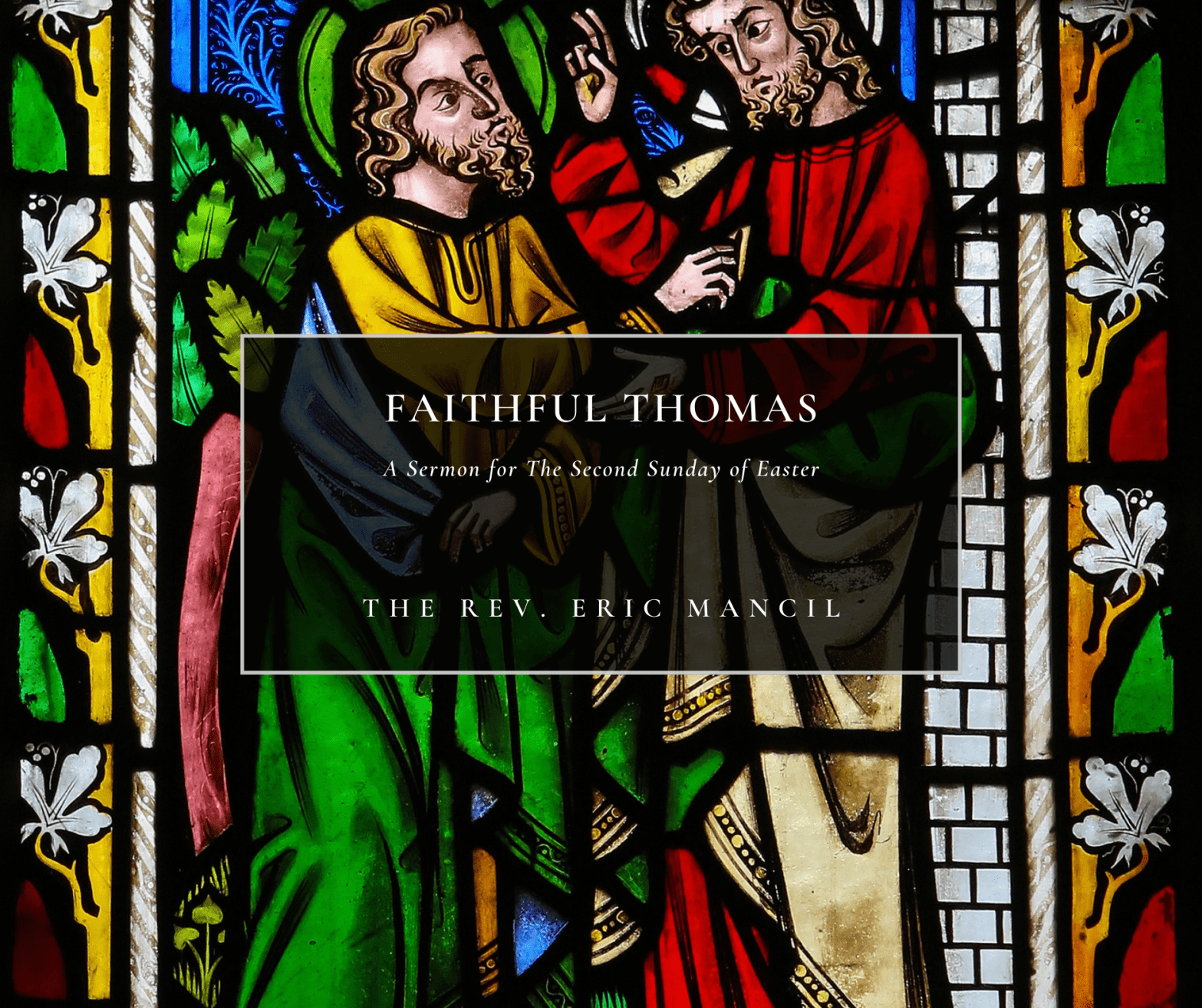
A Sermon for The Second Sunday of Easter (Year B)
April 11, 2021
Text: John 20:19-31
I speak to you in the name of our loving, liberating, and life-giving God: Father, Son, and Holy Spirit. Amen.
It’s been one week since Easter Sunday. One week since we celebrated the glorious resurrection of our Lord Jesus Christ with Easter hymns and shouts of “Alleluia.” One week since our children came up to the front of the church during the 10:30 service to “flower the cross,” signifying our Lord’s victory over death. It’s been one week since we marked the occasion with a children’s Easter egg hunt on the front lawn of the church and enjoyed the beautiful, springtime weather that God provided for us.
It’s been one week since we did all these things, but in a way, it already seems like a distant memory. Holy Week and Easter have come and gone, and now we’re back to life as usual.
And yet, if you look at the front of your bulletin for today, you’ll notice at the top where it says, “The Second Sunday of Easter.” In the Episcopal Church, Easter isn’t just one day of joy and celebration. It’s actually an entire season of the Church year, beginning on Easter Day and lasting all the way through the Day of Pentecost. We get to celebrate our Lord’s resurrection, not just for one day but for fifty days. While grocery stores have already marked down their bags of Easter candy and department stores have already put up their Easter decorations and started preparing for the next major holiday, here we are, still basking in the joy of Easter. The world around us has already moved on, but the Church has only just begun.
We know that there are still important parts of the story to hear and lessons to learn. We know that the story of that first Easter morning didn’t end with Mary Magdalene discovering the empty tomb of Jesus. It was only the beginning.
Today’s lesson from the Gospel according to John picks up right where we left off last Sunday. In the evening, on the day of resurrection, the risen Jesus mysteriously appears to his disciples for the first time. Despite the doors of the house being locked where the disciples have gathered, Jesus appears, and he says to his friends, “Peace be with you.” As evidence that he’s truly returned, Jesus shows them the mark of the nails in his hands and the side of his body, where he was pierced, and he says to them once again, “Peace be with you.” These are comforting and familiar words to us as Episcopalians. I’m a little surprised that the disciples didn’t respond to Jesus by saying, “And also with you.”
After he says this, Jesus wastes no time. In that same moment, he commissions his disciples to go forth into the world, proclaiming the Good News, saying to them, “As the Father has sent me, so I send you.” Then, he empowers them to do this work with the Holy Spirit by breathing on them and saying, “Receive the Holy Spirit. If you forgive the sins of any, they are forgiven them; if you retain the sins of any, they are retained.”
All of the disciples are there, accept one—Thomas, who was called the Twin. For some unknown reason, Thomas isn’t with the rest of the disciples when Jesus first appears. He shows up later and has to be told what happened by the other disciples. At first, Thomas is skeptical and doesn’t believe them. He says, “Unless I see the mark of the nails in his hands, and put my finger in the mark of the nails and my hand in his side, I will not believe.” Because of his reluctance to believe on word alone, history has given Thomas the unfortunate nickname, “Doubting Thomas.” Of course, we know how this part of the story ends. Jesus appears to the disciples again a week later, and this time, Thomas is with them. This time, Thomas sees for himself the risen Christ and declares to him, “My Lord and my God.”
Yes, it’s unfortunate that history has given Thomas the nickname, “Doubting Thomas,” as if questioning the truth of the resurrection, based on word alone, was such a terrible mistake. Can we really blame Thomas for wanting to see for himself what the other disciples witnessed firsthand? Can we honestly say that we wouldn’t have done the same thing if we were in his position? Think about it for a moment. How many times in our own lives have we believed something that was “too good to be true” only to be let down later. Usually, if something is “too good to be true,” it probably isn’t true at all. We have to see it to believe it.
In my opinion, what many of us perceive as Thomas’ lack of faith isn’t actually a lack of faith. It’s a holy curiosity. It’s a longing and desire to see for himself this miraculous turn in the story. It’s a longing and desire to see for himself if what was once dead can truly be raised up again, if what was lost can once again be found. Curiosity is an attribute that Thomas demonstrates in other parts of the Gospel as well.
Think back to that part of the story when Jesus was with his disciples on the night before he was crucified. Among many things, he told them that he was going to prepare a place for them. He said, “You know the way to the place where I am going.” Curious about what Jesus told them, Thomas said, “Lord, we do not know where you are going. How can we know the way?” Jesus replied, “I am the way, and the truth, and the life. No one comes to the Father except through me. If you know me, you will know my Father also. From now on you do know him and have seen him.”
I imagine that, when Thomas saw the risen Christ for the first time, he recalled what Jesus had told them. “If you know me, you will know my Father also. From now on you do know him and have seen him.” Perhaps it was this memory that inspired Thomas to say to Jesus, “My Lord and my God.” Perhaps it was this memory, combined with the experience of seeing Jesus again with his own eyes, that gave Thomas the strength and courage he needed to go forth into the world to spread the Gospel.
Like Thomas, we need those moments of grace to sustain us in our lives in Christ. We need to witness with our own eyes those outward and visible signs of new life and resurrection. They give us strength and courage. They inspire us and motivate us to continue our walk with Jesus. Without them, it can be easy to forget why we were called in the first place. Without them, it can be easy to forget the importance of our calling. There’s so much darkness in the world around us. We see it every day in the news, from stories of racial injustice and violence to stories of mass shootings and political corruption. We need to witness those moments of new life and resurrection to remind us that God’s Kingdom is still worth fighting for. We need those moments to remind us of the bold proclamation we make as Easter people: Christ is risen, and death is defeated, once and for all!
It isn’t wrong to look for signs of new life and resurrection. If we open our eyes, we can see examples springing up all around us, like last Saturday at the Great Vigil of Easter, when we baptized Evey Thibodeau and welcomed her as the newest member of the Body of Christ. It isn’t wrong to ask questions or to explore God’s creation with a sense of holy curiosity. In fact, I would say it’s the exact opposite. It’s good for us. It’s a sign of hope for what’s to come, a sign of faithfulness. Perhaps, then, we should petition to change Thomas’ nickname to “Faithful Thomas” rather than “Doubting Thomas.”
Just because we can no longer see the risen Christ as he revealed himself to the disciples doesn’t mean that we can’t see signs of Easter. They’re everywhere, all around us, if we’ll only take the time to open our eyes and look. The story of Jesus’ resurrection didn’t end at the conclusion of the Gospels. It continues through us—through our willingness to look for the risen Christ and to serve as the hands and feet of Christ in the world. Amen.
A video of this sermon is available below, beginning at the 16:40 mark.
 The Rev. Eric Mancil