
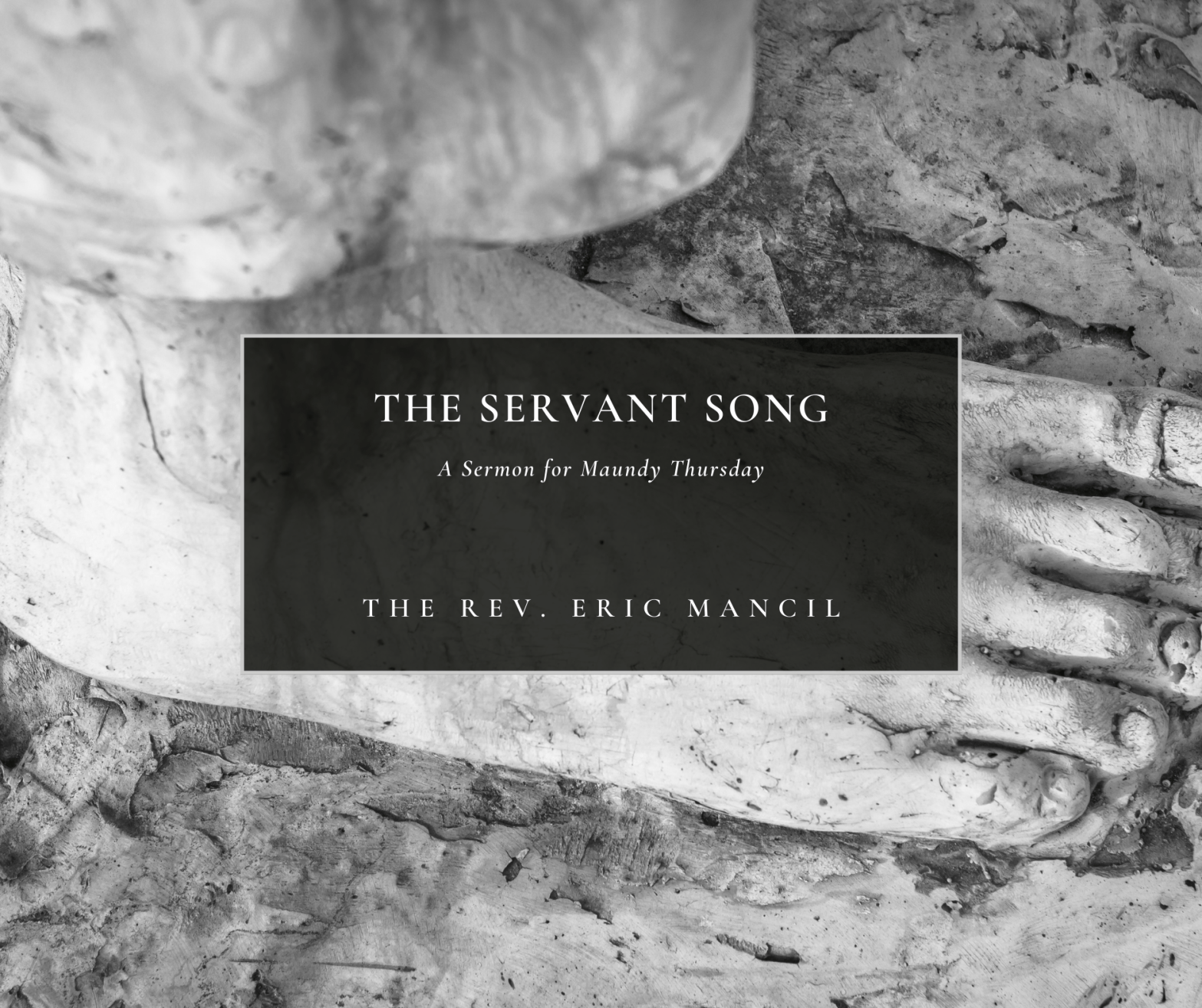
A Sermon for Maundy Thursday
April 1, 2021
Text: John 13:1-17, 31b-35
I speak to you in the name of our loving, liberating, and life-giving God: Father, Son, and Holy Spirit. Amen.
Years ago, when I was a student at Auburn University, I attended St. Dunstan’s—the Episcopal student center on campus. One of my favorite services to attend at St. Dunstan’s was our weekly Folk Mass, which was held on Tuesdays at 5:30 in the evening.
This service was very different than our normal, Sunday evening service at St. Dunstan’s. For example, there were no fancy vestments. The priest usually just wore a clergy shirt and a stole, something very simple. We didn’t all sit in rows of chairs, facing the altar at the front of the church. Instead, we set up at altar table in the center of the Nave, with groups of chairs surrounding it on each side so that everyone could clearly see what was happening. There was no organ music, and there were no hymns from the hymnal, either. In place of these were guitars and songs from the Alleluia 2 songbook. Some of you may be familiar with these songs, especially if you’ve been to Camp McDowell or attended a Cursillo weekend.
Some of my favorite spiritual songs come from the Alleluia 2 songbook, songs like “Here I Am, Lord” and “They’ll Know We are Christians by our Love” and “May the Road Rise with You.” I have such fond memories of these songs, and every time I get to sing them, it brings me back to places like St. Dunstan’s and Camp McDowell—sacred places that’ve formed me in my life in Christ.
There’s another song from the Alleluia 2 songbook that’s always meant a great deal to me. It’s called “The Servant Song,” and every time I read our passage from tonight’s Gospel reading, I’m reminded of the lyrics.
The first verse goes like this:
Won’t you let me be your servant.
Let me be as Christ to you.
Pray that I may have the grace
To let you be my servant, too.
It’s the last part of that verse that causes me to stop and think every time I sing it. “Pray that I may have the grace to let you be my servant, too.”
It’s hard to let others serve us, isn’t it? It’s hard, especially when we don’t have to do anything in return. I think most of us would probably agree that we’d much rather serve others than allow ourselves to be served. We’d much rather be like Jesus in tonight’s Gospel lesson from John, who gets up from the dinner table after supper, ties a towel around his waist, and begins to wash the feet of his disciples—an act of lowly service normally reserved for women and household slaves in the time of Jesus. It’s one of the final things Jesus will do before he’s arrested later in the evening and handed over to Roman guards.
We’d much rather be the one washing feet than having our own feet washed. To be served as Jesus served his disciples, without anything expected in return, requires a certain amount of vulnerability, of letting go of our need for control, and a willingness to accept the fact that we are loved for who we are, exactly how God made us.
But, that’s easier said than done. We spend so much of our time and energy trying to convince ourselves that we don’t deserve to be loved in such a way, that we don’t deserve to be loved and cared for in the way that Jesus demonstrates to his disciples.
The exchange between Jesus and Peter, in tonight’s Gospel lesson, is a good example of what I’m talking about. When it’s Peter’s turn to have his feet washed by Jesus, Peter looks at him, astonished, and asks, “Lord, are you going to wash my feet?” He can’t believe that Jesus—his Lord and master—would do something normally done for him by a servant. He can’t believe that Jesus would get down on his own two knees, roll up his sleeves, and wash the dirt and grime from his feet. Jesus tells him, “You do not know now what I am doing, but later you will understand.” Peter responds adamantly, “You will never wash my feet.” But, Jesus says to him, “Unless I wash you, you have no share with me.”
In other words, Jesus says to Peter, “Unless you learn what it means to be served—unless you know what it feels like to be loved unconditionally, you’ll never understand the ministry to which I’m calling you as my disciple.”
Peter doesn’t see himself as worthy of such a lowly and humble act of service by Jesus. His reluctance to be served in such a way is similar, I think, to the way many of us respond in similar situations.
Think about it for a moment. How many of us politely refuse when someone offers to serve us? I’ll be the first person to admit it. When asked if someone can do something for us, how many of us respond with something along the lines of, “Oh, no thanks! I’ve got it!” or “No, don’t worry about it! I can do it myself!” We need to be in control, don’t we? We’d much rather handle things ourselves than allow someone else to handle them for us. We’d much rather bend down and wash our own feet than allow another person to do it.
What we fail to recognize, though, is that, by denying others the opportunity to serve us, we’re limiting ourselves and our ability to learn more about the love of God in Christ Jesus. When we deny others the opportunity to serve us, we’re limiting our ability to draw closer to Jesus and to learn more about what it means to be his disciple.
That’s really what this night is all about—drawing closer to Jesus, like his disciples did on that final night in the upper room.
During the service for Maundy Thursday, it’s a tradition in the Episcopal Church to include the ritual washing of feet, not only as an act of remembrance but also as an act of participation in the servant ministry of Christ. We do it as a way to remember and acknowledge who we are as followers of Jesus so that we can go out and be ready to wash the feet of those who need to be loved and cared for the most.
In just a moment, I’m going to invite those of you who would like to participate to come up in front of the altar and have your feet washed. You’ll also have the opportunity to wash the feet of the person who washed yours. If you don’t feel comfortable doing it, that’s okay. It isn’t required that you participate, but I want to encourage you to give it a try, especially if you’ve never done it before.
By washing each other’s feet and taking the time to serve one another, we grow in our discipleship and carry with us the commandment that Jesus left with his disciples: “Love one another. Just as I have loved you, you also should love one another. By this everyone will know that you are my disciples, if you have love for one another.”
Resist the idea, dear friends, that you’re unworthy of being loved as Christ loves you. You are worthy, and you are loved. Resist the idea that you need to do everything on your own and have no need to be loved and served by others. There is a need. It’s how we grow more and more into the image and likeness of the God who made us.
In the words of “The Servant Song,”
Won’t you let me be your servant.
Let me be as Christ to you.
Pray that I may have the grace
To let you be my servant, too.
Amen.
 The Rev. Eric Mancil