
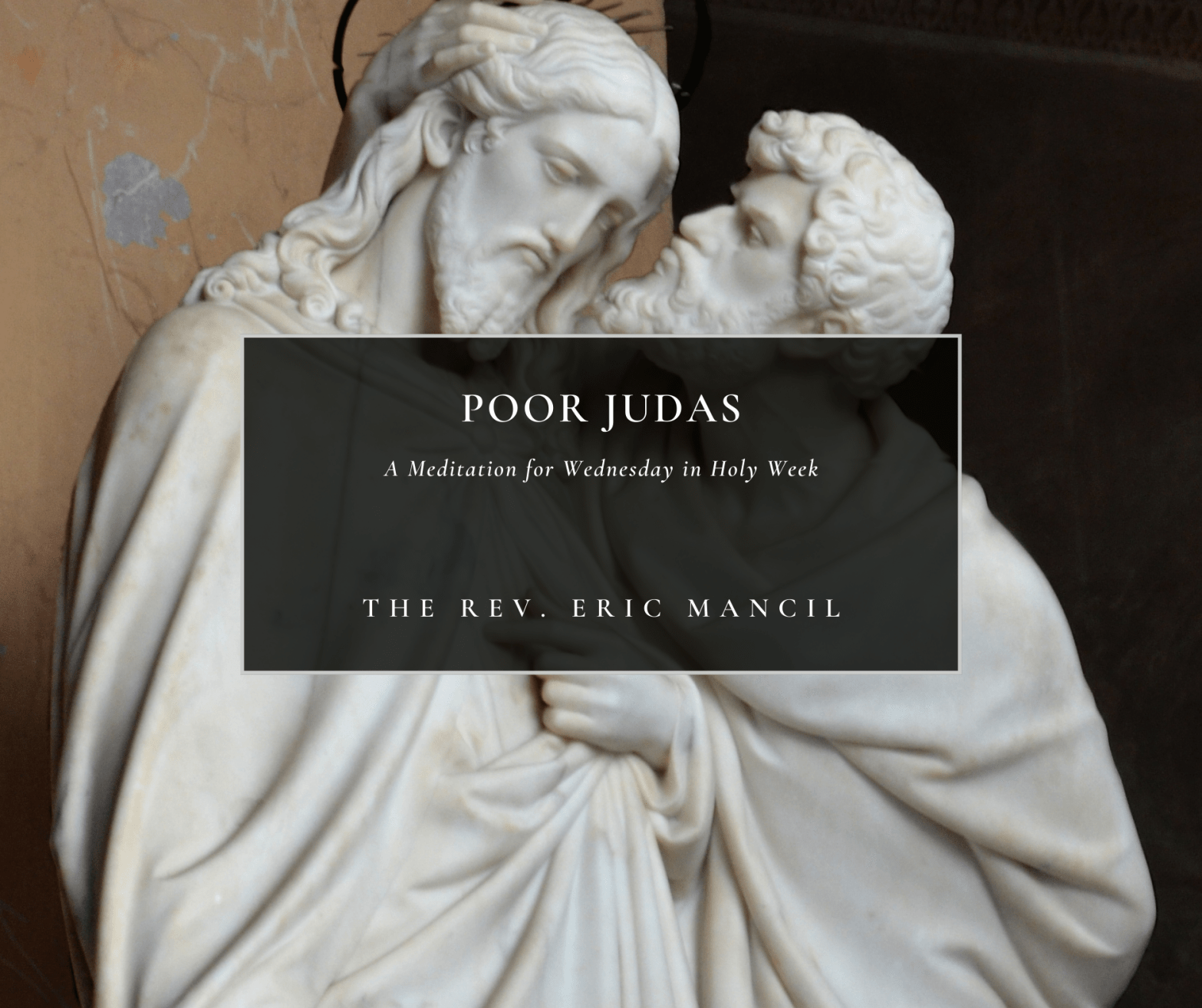
A Meditation for Wednesday in Holy Week
March 31, 2021
Text: John 13:21-32
I speak to you in the name of our loving, liberating, and life-giving God: Father, Son, and Holy Spirit. Amen.
I have a confession to make, one that might seem controversial to most people. I actually feel kind of sorry for Judas Iscariot. I know what you might be thinking. “How could you feel sorry for the man who betrayed Jesus?” But, hear me out for a moment.
The Gospels clearly state that Judas was a thief. He carried the common purse and often stole money from Jesus and the other disciples, money that probably would’ve been used to help the poor and needy.
I know that Judas wasn’t someone you’d look to as the model disciple. Like we heard on Monday in our Gospel lesson from John, Judas criticized Mary of Bethany for the loving act of devotion she showed toward Jesus when she anointed his feet with oil, preparing him burial.
And yet, despite all these things, Judas Iscariot was chosen by Jesus to be one of the twelve apostles. Think about it. He was chosen by Jesus to travel alongside him in his ministry, to learn from him, and to spread the Good News to the people of Galilee that the Kingdom of God has come near. Like Simon Peter and his brother, Andrew, and James and John, the sons of Zebedee, Judas was chosen for a reason. Out of all the people Jesus could’ve called, he chose Judas—a person who was willing to trade Jesus’ life for thirty pieces of silver.
It’s often said that God doesn’t call the equipped. God equips the called. God calls the most unprepared, unqualified, and unexpected people to do God’s work, and we see examples of that all throughout the Scriptures. Judas is just one more example.
I think the most tragic part of Judas’ story isn’t the fact that he betrayed Jesus. It’s the fact that he didn’t get to experience reconciliation and forgiveness, at least not in his earthly life. We learn in the Gospel of Matthew that Judas was so consumed with guilt over his betrayal of Jesus that he took his own life. He never got to experience the resurrected Christ or to hear Jesus speak the words, “I forgive you.”
I suppose the real reason I feel kind of sorry for Judas is because his name has become synonymous with betrayal. Yes, he betrayed Jesus in one of the worst ways imaginable, but then again, so did the other apostles. In Jesus’ moment of need—in the moment he needed his friends the most—they all fled and hid away, afraid that they would suffer the same fate as their teacher. Yes, Judas betrayed his friend, but then again, all of us are guilty of betraying Jesus. Every time we turn our back on someone in need of help. Every time we refuse to hear the cries of the oppressed and downtrodden. Every time we forget that each of us is made in God’s image and worthy of love and respect, we betray Jesus.
The Good News, dear friends, is that God is always ready to forgive us. No matter how far we’ve fallen. No matter our betrayal. No matter our refusal to follow in the way of love. God is ready to forgive. On this Holy Wednesday, may we see clearly our need to be forgiven, and may God grant us the strength and wisdom to be faithful in our calling. Amen.
 The Rev. Eric Mancil