
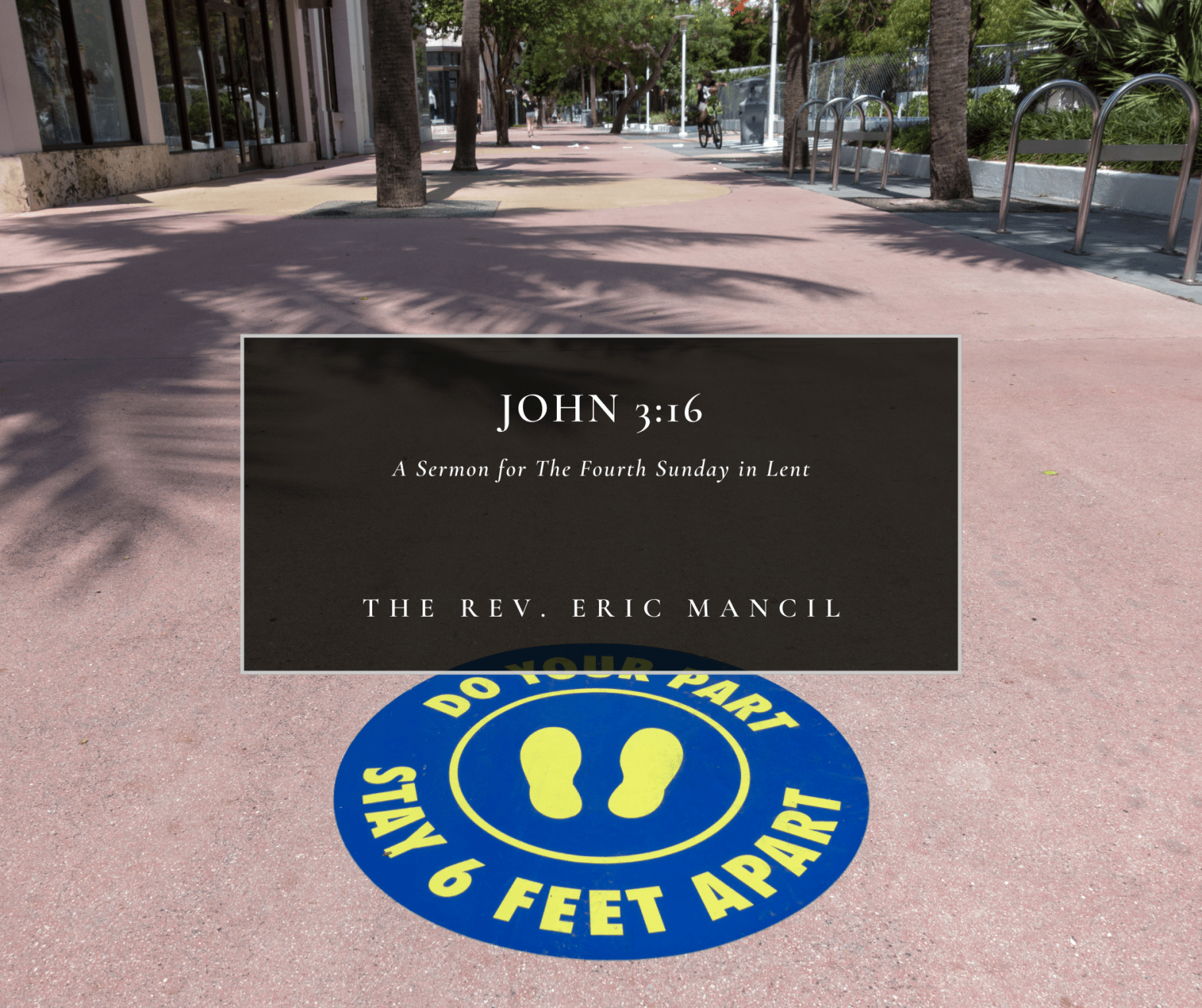
A Sermon for the Fourth Sunday in Lent
March 14, 2021
Text: John 3:14-21
I speak to you in the name of our loving, liberating, and life-giving God: Father, Son, and Holy Spirit. Amen.
Do you remember what life was like before the pandemic, before our lives were turned upside down and the world completely changed? I do. I remember what it was like. Though, I have to admit that, in some ways, it feels like a lifetime ago.
I know that, before the pandemic, we didn’t have to worry so much about going out in public and being in large groups of people. We took for granted the ability to go wherever we wanted without giving much thought to whether or not we’d get sick or infect others with an unknown virus.
I know that we didn’t wear masks wherever we went, and we didn’t concern ourselves with standing six feet apart from strangers.
I know that we didn’t worry about rushing to the grocery store at the drop of a hat for fear of running out of food or hand sanitizer or toilet paper.
I know that we didn’t have to worry about whether or not our loved ones would have to be alone in the hospital or in a nursing home.
I know that we used to shake hands with people we just met as a sign of respect and hospitality. I know that we used to give hugs when we “passed the Peace” in Church and when we said goodbye after the service was over. I know that we used to enjoy meals together in the Parish Hall. I know that we used to sing hymns and kneel together at this altar rail and receive the Body and Blood of Christ every Sunday morning without any concern at all.
I know all these things, and yet, they feel like a distant memory.
Our lives have changed in so many ways over the past year, and I think we’ve only just begun to consider the long-term effects this virus will have on us. We’ve only just begun to think about what our lives are going to be like once we return to some sense of normalcy. I think we can all agree that, moving forward, many things are going to be different than the way they were before the pandemic.
I had some time to reflect on all of this during the past week as we marked the one-year anniversary. It’s been one year since the World Health Organization declared COVID-19 a global pandemic. It’s been one year since I received that first e-mail from Bishop Kee, announcing that all public worship services and gatherings at the church would have be suspended.
How naive I was, in the beginning, to think that all of this was going to blow over in a matter of weeks. How naive we all were, looking back to March of last year, to think that none of what we’ve experienced over the past twelve months was ever a possibility.
Yet, here we are, one year later. Over half a million people have died in our country as a result of the virus, including a member of our own parish, Paul Clausmeyer—a beloved friend and father. We know others who’ve died as well—friends, family members, co-workers, and loved ones—all lost, but not forgotten. This virus has taken a toll far worse than any of us could’ve predicted or imagined.
We’ve endured much suffering, and while we still have a ways to go before we can take off our masks for the last time and resume many of the things we enjoyed before the pandemic, we’re beginning to see a light at the end of the tunnel. Vaccinations are being developed and distributed all over the world, and eventually, all of us will have access to it. Eventually, enough of us will be vaccinated to where we can finally breathe again and feel comfortable doing the things we love most with the people we care about, including here at church.
The reason why I’m talking about the pandemic this morning is because I think our shared experience over the past year has taught us a lot about who we are as followers of Jesus. It’s caused us to give careful consideration to how our words and actions affect the lives of those around us.
Living through this experience together as a faith community, even though we’ve struggled and had to sacrifice a lot, has taught us so much about what it means to love others as Jesus teaches us in the Gospels. I’m not exaggerating when I say that we’ve walked the way of the Cross with Jesus over the past twelve months, and through all of it, God has been with us, guiding us and giving us the strength we need to endure.
In our Gospel lesson this morning from John, we heard one of the most well-known and beloved verses from Scripture among Christians: John 3:16. Many of us probably have this verse committed to memory. “For God so loved the world that he gave his only Son, so that everyone who believes in him may not perish but may have eternal life.”
This verse from John’s Gospel brings me so much comfort in my life, as it does for so many. But, the comfort I feel when I read it doesn’t come from what you might expect.
We often misinterpret what Jesus was trying to say in this verse. We forget that this passage is actually part of a much longer conversation that Jesus had with a man named Nicodemus, a Pharisee who came to Jesus in secret in order to learn more about him and his teaching. In their conversation together, Jesus tries to explain to Nicodemus that, in order to enter the kingdom of God, in order to experience the abundant life that God desires for all of us, one must be willing to give up their life and be re-born. One must be committed to living a life of self-giving, sacrificial love for the other.
Contrary to what many people think, John 3:16 isn’t Jesus’ way of saying, “Follow me, or else!” It doesn’t have anything to do with where we go when we die or where we spend eternity.
It’s Jesus’ way of saying, “My way of love is the way of God.” It’s his way of saying, “My way of self-giving, sacrificial love is the path that leads to true joy and true peace with God.”
Once again, this verse doesn’t have anything to do with who’s in and who’s out, and it doesn’t have anything to do with God’s love being limited to only a certain group of people.
God loves each of us the same, more than any of us deserves, and nothing can ever change that.
Martin Luther, the sixteenth-century, German monk who sparked the beginning of the Protestant Reformation, once referred to John 3:16 as “the Gospel in Miniature.” He believed that everything you need to know about Jesus and the Gospel could be learned from this one verse of scripture.
And, I think he had a pretty good point.
Everything we really need to know is right there, printed in your bulletin this morning. When it’s all said and done, the message of the Gospel, the Good News of God in Christ, is that God loves us more than we can possibly imagine. God loves us so much that he came to dwell among us, to live and die as one of us, to teach us and show us a better way to live. God loves us so much that he sacrificed himself on the cross to show us that a life lived in the service of others is the only path to abundant life with God.
So, I want to leave you with a question this morning. You don’t have to answer it right now, but I’d like you to give it some thought in the days ahead, especially as we draw closer to Holy Week. Do you really believe that that the message of the Gospel is Good News? Do you believe that dying to self and committing to a life of sacrificial love and service to others is the path to abundant life with God?
If your answer is “yes,” then you should know the sacrifices we’ve made and the precautions we’ve taken over the past year in order to keep ourselves and others safe have been worth it. If you really believe that the Gospel of Jesus is true, then we’ve been faithful over the past year. Every time we made a sacrifice, knowing that it might keep others safe, we’ve been faithful. We’ve been faithful every time we wore a mask, even when it was inconvenient. We’ve been faithful every time we restrained ourselves from hugging a friend or decided to stay at home instead of going out with a large group of people. We’ve been faithful every time we tuned in online to watch church from home, even though we wanted so desperately to be together in person. Don’t think, for a moment, that the choices we’ve made in order to keep others safe were made in vain. Those choices were made in love and service to God and God’s people.
Now, we’re being called to remain vigilant as this pandemic continues. Yes, we’re beginning to see a light at the end of the tunnel, but that doesn’t mean that we can rest easy just yet and go back to the way things were before. Now isn’t the time to stop believing that our words and actions make a difference. Now is the time to remain vigilant.
God has been with us through it all, even in the most difficult moments, and God will continue to be with us until this is all over. That’s God’s promise to us, and that promise will never end. So, hold onto hope, dear friends. Hold onto the knowledge that the way of Jesus is the way of love and the way to abundant life with God. Amen.
A video of this sermon is available below, beginning at the 13:48 mark.
 The Rev. Eric Mancil