
A Sermon for the Fourth Sunday after the Epiphany (Year B)
January 31, 2021
The Gospel: Mark 1:21-28
I speak to you this morning in the name of our loving, liberating, and life-giving God: Father, Son, and Holy Spirit. Amen.
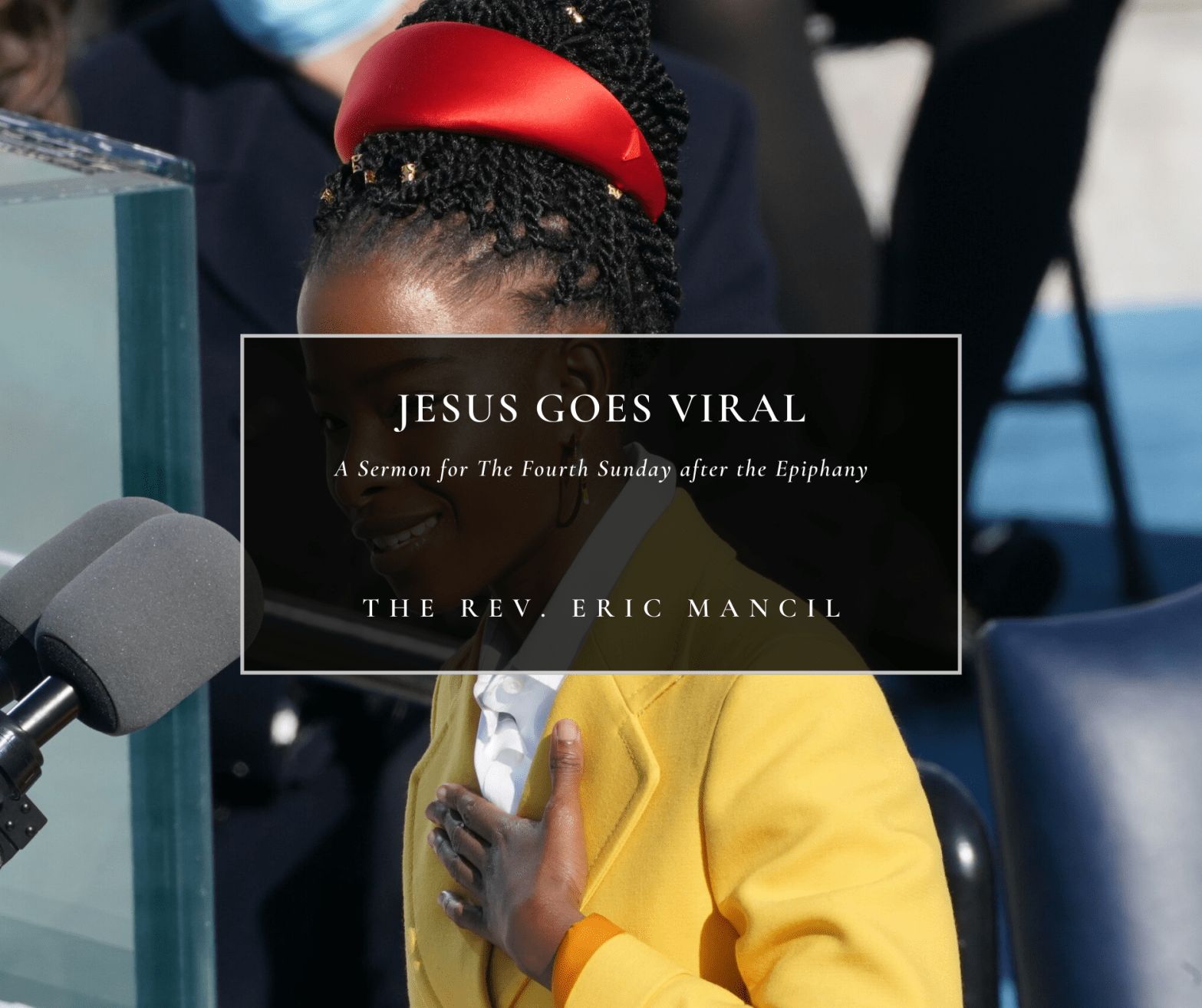
Last week, during the presidential inauguration, the world heard from an impressive, young lady named Amanda Gorman, who is the nation’s first-ever youth poet laureate and the youngest person to ever read a poem at a presidential inauguration.
In an interview she gave after the inauguration, she shared that she began working on the poem weeks before the event but then later changed the poem’s wording to reflect the tragic events that took place in our nation’s capital on January 6th. In an article published by The Washington Post, she said, “My hope is that my poem will represent a moment of unity for our country” and “with my words, I’ll be able to speak to a new chapter and era for our nation.”
In the hours and days following the inauguration, Amanda went viral. Pictures and quotes from her performance at the inauguration began popping up all over social media. Almost instantly, everyone knew who Amanda Gorman was, and more importantly, they loved what she had to say. Even our Presiding Bishop, Michael Curry, took notice of Amanda and her poem and included part of it in his most recent address to the House of Bishops.
It doesn’t matter whether or not you voted for President Biden in the election. It doesn’t matter whether you consider yourself a Republican or a Democrat or anything in between. Amanda’s words, in that moment, were offered as a balm of healing for our country. Her words were offered as a source of comfort and hope to a divided nation at a time when we need them most. She didn’t seek to alienate anyone or to point fingers. Her hope was to help make “e pluribus unum” a reality, the motto of the United States of America, “Out of many, one.”
As I was reading our Gospel lesson for today, I was reminded of Amanda’s performance at the inauguration and the overwhelming sense of encouragement I felt as I watched this twenty-two year old, African American woman offer her words to the rest of the country. Jesus, in today’s Gospel lesson, offers the same sense of hope and encouragement in his words to the people of Capernaum. The author of Mark’s Gospel isn’t specific on exactly what Jesus says, but from the reading, we know that the people were “astounded at his teaching.” Mark literally uses the word “astounded” as a way to describe the people’s reaction to Jesus’ words. Here is a man, probably no more than thirty years old, at the beginning of his ministry. It’s likely that he has no formal training as a rabbi. He has no position of authority and no right to get up in the middle of the synagogue and begin teaching. And yet, that’s exactly what he does. He defies expectations, and even more than that, Jesus demonstrates for the people that his ministry, his way of love, will be a source of healing for all people. After he’s done teaching, a man whom the Gospel writer refers to as “a man with an unclean spirit” comes up to Jesus and says, “What have you to do with us, Jesus of Nazareth? Have you come to destroy us? I know who you are, the Holy One of God.” Jesus rebukes the unclean spirit and says, “Be silent, and come out of him.” At once, the man who was tormented by the unclean spirit is healed and restored to fullness of life.
Once again, the people are astounded by Jesus, but this time, they’re astounded for a different reason. They look around and say to one another, “He commands even the unclean spirits, and they obey him.” There’s something different about this man.
Well, word travels fast, and almost overnight, everyone in the region of Galilee knows who this Jesus is. You might say that Jesus goes viral.
Why do you suppose that happened? Why do you think that news traveled so quickly about this young man from Nazareth who taught with authority and had the power to heal the man with an unclean spirit?
I think it’s because most people have a built-in desire to be inspired and hopeful. I think it’s also because most people want to share with others the things that inspire them and give them hope. Think about social media, for example. Now, I know there’s a lot of negativity and misinformation on Twitter and Facebook and other websites, but I find that most people, regardless of their political or even religious beliefs, tend to share things that they find comforting and meaningful, things that might bring a sense of comfort and peace to others.
Perhaps that’s the reason why news traveled so fast about Jesus and his ministry of teaching and healing. People want to inspired and hopeful.
Perhaps that’s also the reason why news traveled so fast about Amanda Gorman and her poem at the inauguration. People want to be inspired and hopeful.
The Gospel of Jesus—the Good News of God in Christ—is both inspirational and hopeful. It speaks of death being defeated, once and for all, of darkness having no dominion over the light. It speaks of unclean spirits being cast out, of the sick being healed, and of the blind being restored to fullness of sight. It speaks of the old heaven and earth passing away and a new creation coming to fulfillment, one where heaven and earth will be joined together for all time. It speaks of self-giving, sacrificial love as the only way to enjoy fullness of life with the God who made us. Not hate. Not resentment. Not fear. Love is the only way.
And this Gospel, this way of Jesus, is ours to proclaim. As members of the Body of Christ, we’ve been called to proclaim it by word and deed, wherever the Spirit may lead us. And, not only have we been called. We’ve been given authority as well.
A little later in the Gospel of Mark, in the third chapter, we hear the story of Jesus appointing the twelve apostles to join him in his ministry and to be sent out to proclaim the Good News and to have authority to cast out demons.
So, you see, like Jesus in the synagogue in Capernaum and like those first disciples of Jesus, who were sent out and given authority to cast out demons, we’ve been given authority to bring healing to the world through the proclamation of the Gospel and to cast out unclean spirits in whatever form they may take. Some that come to mind include: the sin of racism and white supremacy. Violence and prejudice toward our LGTBQ brothers and sisters. Unfair treatment of those who live on the margins—the poor, the homeless, and the hungry; those with different religious beliefs and backgrounds; and those who come to us seeking refuge from violence and oppression in other parts of the world.
My friends, unclean spirits come in a variety of shapes and sizes.
“Be silent, and come out of him,” Jesus says to the unclean spirit in our Gospel lesson for today.
What will our words of healing be? What words and actions will we use to cast out the unclean spirits of our own time and bring healing to the world?
Prayer without action isn’t enough. Yes, we need to say our prayers, but even more importantly, we need to live them. A couple of years ago, as I was attending an evangelism conference sponsored by the Episcopal Church, I heard our Presiding Bishop say these words: “Sometimes when we’re faced with tragedy and heartbreak, we’re tempted to say, ‘All we can do is pray.’ But, that’s not true. You have a heart. Use it. You have a heart that has the ability to break open. Let it. Let it break open, and allow the love of Jesus to flow through it.”
I leave you with these last few lines from the inaugural poem, “The Hill We Climb,” by Amanda Gorman.
When day comes we step out of the shade,
aflame and unafraid,
the new dawn blooms as we free it.
For there is always light,
if only we’re brave enough to see it.
If only we’re brave enough to be it.
Amen.
A video of this sermon is available below, beginning at the 16:00 mark.
 The Rev. Eric Mancil